|
Canada Bureau
LEAD IN DRINKING WATER - ONTARIO
Ontario schools get an “F” according to a report published by the Canadian Environmental Law Association (CELA)
Ontario is putting children at risk by allowing higher levels of lead in school drinking water than most of the country, says a new analysis by the Canadian Environmental Law Association (CELA).
“Lead is more dangerous than we previously thought, especially for children. Other provinces and territories are responding to this science with the seriousness it demands, but Ontario has fallen behind,” said Julie Mutis, Community Outreach worker with CELA.
The report, “‘F’ for Effort: Ontario is falling behind on getting lead out of school drinking water,” shows how Ontario’s failure to update its nearly 20-year-old regulation is putting people at risk.
“Although Ontario has been regulating lead in school drinking water since 2007, children continue to be exposed to it today. Ontario has gone from a leader in school drinking water safety to the bottom of the class,” said Mutis.
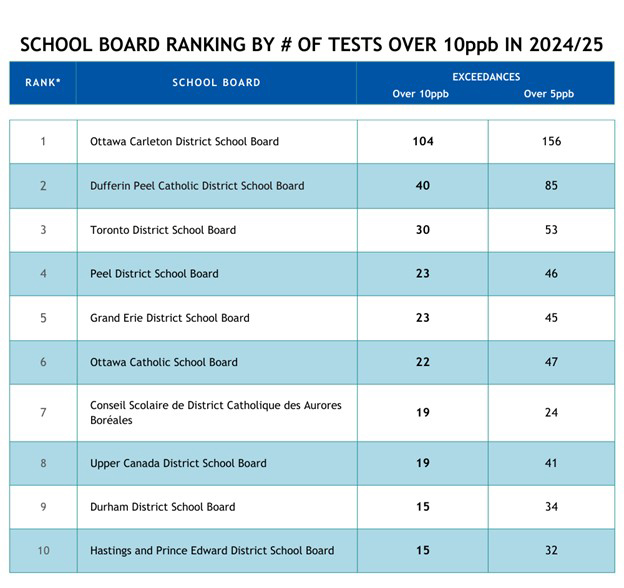
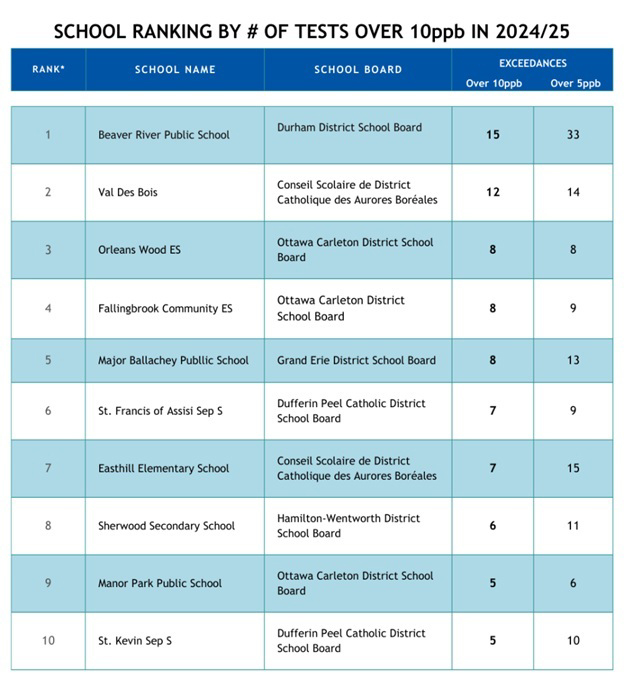
The report uses provincial data to rank the school boards and individual schools that had the highest number of lead tests exceeding 10ppb in 2024/25, but notes that the true scope of the problem is likely being underreported.
“Many schools with known lead infrastructure have been exempt from regular testing and are not represented in the data. This is because Ontario still uses an outdated limit on lead in water to decide where and when testing is required,” says Mutis.
Ontario is one of only two provinces and territories that have not adopted Health Canada’s strengthened limit on lead in drinking water, which was lowered from 10 parts-per-billion (ppb) to 5ppb in 2019.
“Ontario is allowing children in schools to drink water that would be considered unsafe in most of the country, and that is not acceptable,” said Mutis.
The report highlights how Quebec has modernized its approach to protecting students from lead exposure. After the new federal guidance was issued in 2019, Quebec required all school water fixtures to be tested and began publicly reporting progress on removing lead from schools.
Since completing screening of all taps and fountains in the summer of 2021, 61 per cent of non-compliant taps in public schools have been removed, replaced, or made safe to use.
“Ontario needs to follow the rest of the country and recognize that no amount of lead is safe, prevent lead exposure using the most up-to-date mitigation methods, and improve how information about school drinking water is shared with parents,” said Mutis.
The school boards with the highest exceedances this year were:
About CELA
Canadian Environmental Law Association (CELA) is a legal aid clinic dedicated to environmental equity, justice, and health.
Founded in 1970, CELA is one of the oldest advocates for environmental protection in the country. With funding from Legal Aid Ontario (LAO), CELA provides free legal services relating to environmental justice in Ontario, including representing low-income and vulnerable or disadvantaged communities in litigation. CELA also works on environmental legal education and reform initiatives.
|