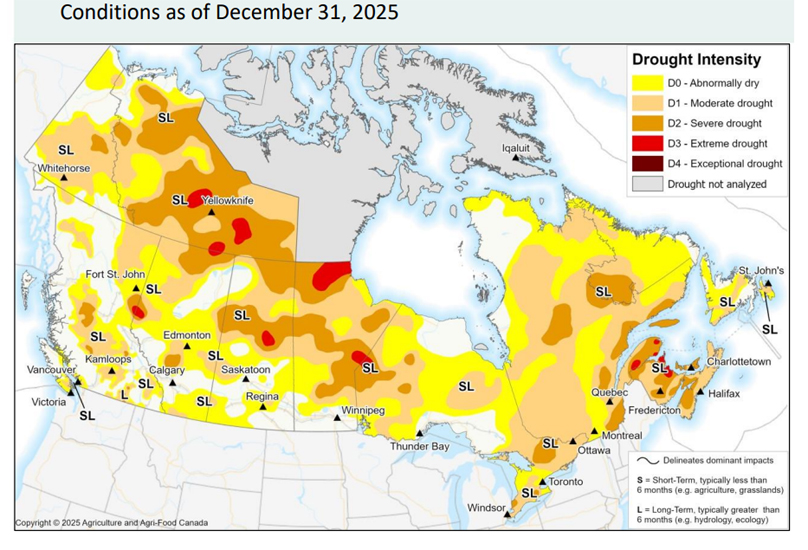
Saskatchewan received near normal December precipitation with most of the province receiving more
than 85% of normal. Monthly temperatures were below normal across the province with the coldest
temperatures anomalies experienced in central areas of the province at more the 4 degrees below
normal. Across southern Saskatchewan, above-normal precipitation led to improvement with reductions
in Abnormally Dry (D0) and Moderate Drought (D1) areas. Western portions of central Saskatchewan
experienced slight improvements this month, including reductions in Abnormally Dry (D0) through
Severe Drought (D2) and reduction in Extreme Drought (D3) around La Ronge. In northern
Saskatchewan, conditions also improved slightly, with reductions in Abnormally Dry (D0) through Severe
Drought (D2), supported by normal to above-normal precipitation.
Most of the Manitoba experienced more than 85% of normal December precipitation except for pockets
of the southeast, southwest, and the north where 40% to 85% of normal precipitation was received.
Monthly temperatures were below normal across the province with most areas seeing temperatures 3
to 4 degrees below normal. In southern Manitoba, above-normal precipitation led to reductions in
Abnormally Dry (D0) through Severe Drought (D2) conditions. Central Manitoba also saw improvement,
including reductions in Moderate (D1) through Extreme Drought (D3) as moisture conditions benefited
from repeated snowfall events. In northern Manitoba, only minor adjustments were made to drought
conditions, with Severe Drought (D2) and Extreme Drought (D3) remaining across much of the region.
Overall, while much of Manitoba experienced improving drought conditions, persistent Moderate (D1)
to Severe (D2) drought continued in parts of the north where moisture deficits remain.
At the end of the month, 79% of the Prairie Region was classified as Abnormally Dry (D0) or in Moderate
(D1) to Extreme Drought (D3), including 62% of the region's agricultural landscape.
Central Region (ON, QC)
In Ontario, drought conditions generally improved in December. Northern Ontario saw notable
improvements, with reductions in Abnormally Dry (D0) to Severe Drought (D2) conditions and a
significant reduction in Extreme Drought (D3). Eastern portions of northern Ontario improved due to
multiple high-impact snowfall events, although lingering dryness persisted near the Ontario–Manitoba
border. Eastern and Central Ontario experienced improvement, with reductions in Severe Drought (D2)
and the removal of the Extreme Drought (D3) pocket, as a result of accumulating snowfall from snow
squalls and clipper systems. Despite recent snowfall, groundwater concerns remain in eastern Ontario,
with Ottawa reporting approximately 25% less precipitation than average for the year and requesting
residents on private wells to limit water use.
In Quebec, December weather conditions were mixed resulting both improvement and worsening of
drought conditions across the province. Drought conditions in northern Quebec improved, with
reductions in Severe Drought (D2) and removal of Extreme Drought (D3) in the southern AbitibiTémiscamingue region thanks to above-normal monthly precipitation. Southeast Quebec experienced
slight worsening of drought conditions, with an expansion of Abnormally Dry (D0) reflecting ongoing
precipitation deficits. The Gaspé Peninsula also experienced worsening conditions, with expansion of
Moderate Drought (D1), the addition of Severe Drought (D2) pockets, and the maintenance of existing
Extreme Drought (D3).
At the end of the month, 86% of the Central Region was classified as Abnormally Dry (D0) or in
Moderate to Extreme Drought (D1) to (D3), including 97% of the region's agricultural landscape.
At the end of the month, 86% of the Central Region was classified as Abnormally Dry (D0) or in
Moderate to Extreme Drought (D1) to (D3), including 97% of the region's agricultural landscape
Atlantic Region (NS, NB, PE, NL)
In New Brunswick, despite near-to-below normal monthly precipitation, soil moisture and surface water
supply conditions continued to improve, with a reduction in Severe (D2) and Extreme (D3) Drought
areas. However, pockets of Extreme drought (D3) persisted in eastern New Brunswick, where longerterm precipitation deficits remain. In Prince Edward Island, drought conditions improved, with the
removal of a pocket of Extreme drought (D3) on the western tip of the island. Despite this improvement,
below-normal seasonal precipitation, particularly in central portions of the island, continued to limit full
recovery.
In Nova Scotia, drought conditions also improved, highlighted by the removal of Extreme
drought (D3) conditions in the southwest region. Most of the province is now classified as Moderate
(D1) to Severe (D2) Drought. Severe Drought (D2) was maintained in parts of southwestern Nova Scotia,
where ongoing precipitation deficits and mixed snowfall amounts have limited drought recovery.
In
Newfoundland, drought conditions improved, with reductions in Abnormally Dry (D0) and Moderate
Drought (D1) and the removal of remaining Severe Drought (D2) areas. Abundant precipitation and
above-normal snowfall, particularly in western and northern regions, supported improvements in soil
moisture and surface water availability. However, localized dryness persisted on the Avonlea Peninsula
and across larger portions of western Newfoundland, where longer-term precipitation deficits remain. In
Labrador, drought conditions improved slightly, with a reduction in Moderate Drought (D1).
At the end of the month, 88% of the Atlantic Region was classified as Abnormally Dry (D0) or in
Moderate to Extreme Drought (D1) to (D3), including 97% of the region's agricultural lands