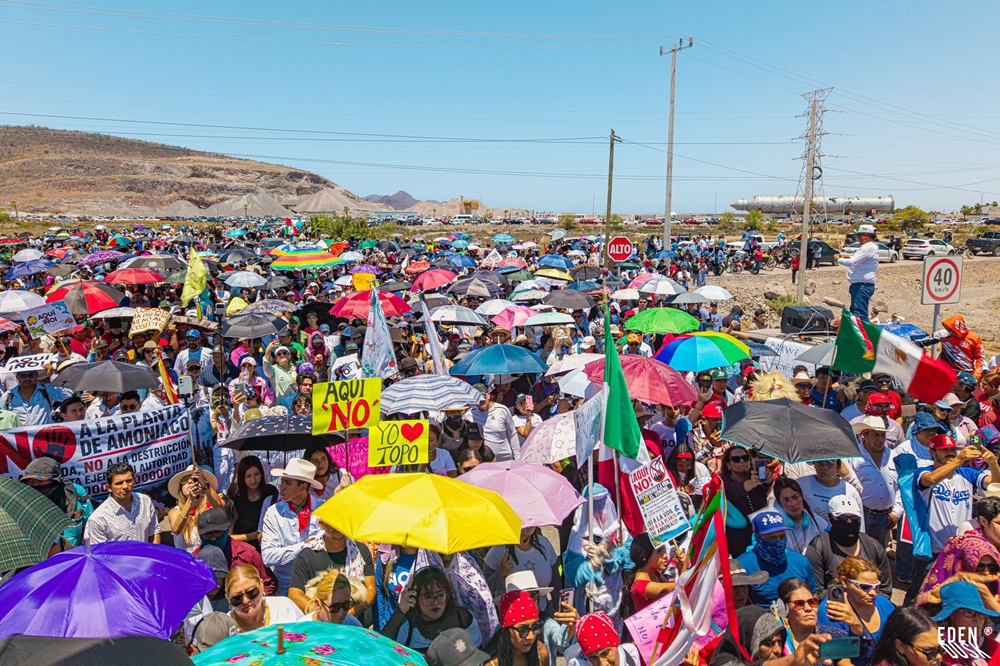
The encampment began May 31 at the Port of Topolobampo, after enormous industrial components arrived by sea. On June 15, protesters moved to the plant’s access road, where they have maintained a round-the-clock blockade aimed at stopping workers, machinery and equipment from entering. By July 29, the occupation had reached its 60th day.
“The project is already over 80 per cent complete, so we have no choice,” said Felipe Montaño, traditional governor of the Yoreme community of Ohuira. “We will fight to the last consequences. If we must give our lives here, we are prepared to do so.”
The plant is being developed by Gas y Petroquímica de Occidente, or GPO, a subsidiary of Switzerland-based Proman. It is designed to produce 2,200 tonnes of anhydrous ammonia a day and store up to 75,000 tonnes on site, making it one of the largest facilities of its kind in Latin America.
Ammonia is widely used to manufacture fertilizer, and Mexican officials describe the project as important to national food security. President Claudia Sheinbaum has defended it, saying it is almost complete and has met legal and environmental requirements. Industry reports placed overall project progress at 88 per cent in May, although production is not expected until 2027.
For the Yoreme communities around Ohuira Bay, however, the project represents a direct threat to a territory that has sustained them for generations.
The plant stands within the 22,500-hectare Santa María–Topolobampo–Ohuira lagoon system, designated under the Ramsar Convention in 2009. Its shallow, mangrove-fringed waters provide habitat for migratory birds and threatened species and serve as nurseries for shrimp, fish, oysters and other marine life that support thousands of fishing families.
The lagoon system also contributes to the extraordinary biological abundance of the Gulf of California, whose islands and protected coastal areas form a UNESCO World Heritage site currently listed as World Heritage in Danger.
Residents first organized against the project in 2014, after seeing mangroves cleared and land filled without having been informed that an industrial facility was planned. The dispute grew into a prolonged legal and political battle over environmental impacts, land rights and Indigenous consultation.
Opponents call the plant “the monster” and “a time bomb.” A communication from 11 United Nations special rapporteurs cited the company’s own environmental risk assessment, which modelled a five-minute rupture of the ammonia pipeline. Under that scenario, a toxic cloud could spread 45 kilometres in diameter and potentially affect more than 400,000 people.
The plant would also withdraw about 2,000 cubic metres of seawater every hour and return warmer, saltier water to the bay. Opponents fear the intake could destroy shrimp and fish larvae, while the discharge could alter the lagoon’s temperature and salinity. Research cited by the movement estimates that shrimp production could decline by more than 500 tonnes a year.
Proman says the plant will use modern safety systems and environmental monitoring. The company and government officials maintain that the project can operate without causing unacceptable harm.
The conflict has also raised questions about who had the right to consent to the project. In 2022, Mexico’s Supreme Court ruled that it had advanced without adequate Indigenous consultation and invalidated key permits. A consultation was later conducted, in which a majority of the participating communities voted in favor of the plant.
But Montaño says the result obscured a crucial divide: the four Yoreme communities surrounding Ohuira Bay all voted against it, while seven more distant communities were also included, leaving those facing the most direct impacts outnumbered.
Montaño and other opponents also allege a “compra de conciencias”—a buying of consciences—saying communities were given food and promised public works and other benefits in exchange for their support.
“The communities that live off the bay and depend on it said no,” Montaño said. “But their voices were diluted by communities that would not suffer the direct impacts.”
Government agencies and the company say the consultation was lawful and that a majority of participating communities supported the project.
The movement’s most visible Yoreme leaders—including Montaño; Melina Maldonado, a rural sociologist and law student; and Claudia Susana Quintero, an educator in Indigenous and women’s rights—have spent years pursuing injunctions, meeting with Mexican officials and taking their case abroad. The three of them have received threats and intimidation, and now receive protection thrugh Mexico's federal mechanism for human rights defenders and journalists.
Maldonado and Quintero travelled to Germany in March of this year to challenge the public financing led by KfW IPEX-Bank. During meetings there, Maldonado delivered a warning: “We are not going to allow a single litre of ammonia to be produced. Your money is at risk.”
The arrival of massive plant components in late May dramatically widened the movement. Images shared through social media made the project’s scale visible to a much broader public. In early June, thousands joined a march and caravan from Los Mochis to Topolobampo, ending with a symbolic closure of the plant. Supporters have since brought food and supplies and taken shifts at the camp.
After five roundtable sessions with government and company representatives in July, the Aquí No! collective was awaiting a government response. Whatever the outcome, movement leaders say the blockade will continue as long as necessary.
“We’ll be here as long as it takes,” said Maldonado.
Tracy L. Barnett is an independent journalist based in Guadalajara, Mexico. She is the founder of The Esperanza Project, a bilingual news magazine covering environmental, indigenous and social movements in Latin America.
Related WT article:
Hollow Water First Nation -- Camp Morning Star land defenders enter third year of maintaining the Sacred Fire opposition to silica sand mining project - February 2022